By,
Deanna Grimstead (She/Her)
In the United States filling out surveys, with their accompanying questions concerning demographics, is commonplace. Some of these surveys are scientific in nature, e.g., surveys for political polling, census polling (necessary aspects of our government), or, most recently, signing up for the COVID-19 (or SARS-CoV-2) tests and/or vaccines. Some of us fill in this information out of a feeling of necessity, a commitment to science, or as a service to and for practitioners. While this service typically offers no compensation or recognition, we often feel compelled to complete these surveys and most of us do not think twice about the language used in collecting demographic data and the possible implications of the words used and presentation of words choices for questions. At times surveys are a painless exercise, while at other times they can be useful opportunities for reflection and thoughtfulness. However, on far too many occasions, such surveys produce deep feelings of frustration, isolation, ‘otherness’ and disappointment for the LGBTQIA+ community. The problem: linguistically powerful, but uninformed, crafting of sex and gender questions and offered responses.
*Note: this is true for other aspects of demographic data collection, but this blog is specifically focused on the LGBTQIA+ community. We will tackle other issues with demographic data collection in future blogs (e.g., race, ethnicity, sex, etc.).
Those who are members or allies of the LGBTQI+ community know exactly to what we refer: the inevitable conflating of sex and gender, the absence of gender as a category, the binary choices provided for sex and/or gender, and the Other category (example below). While recognizing that these issues continue to be sources of debate as there are scholars who strongly insist on identifying sex as a biological category and gender as a social construct, others see both sex and gender as socio-cultural constructions (Toward a Feminist Theory of the State, etc. – see further readings below). We do not wish to debate or debunk the theories around sex and gender presently, but rather to uphold and advocate for an embrace of the spectrum of diverse human expression and experience.
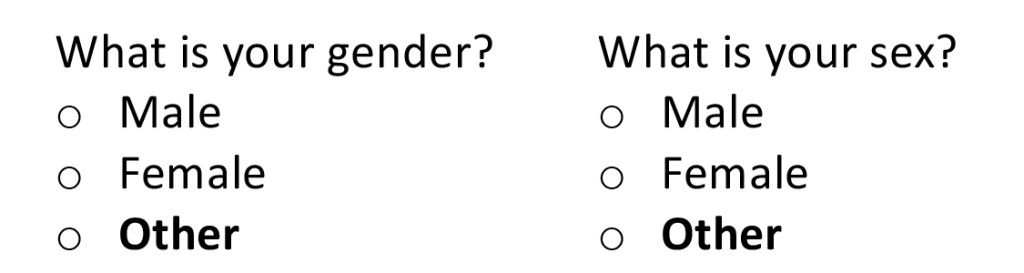
Here we only mean to ask for a more LGBTQI+ inclusive choice of categories and options. The choices provided, the language used and the structure of presentation matter. Such surveys reinforce cultural constructions and the limitations these constructions impose of binarity and the marginalization of the non-binary.
Gender Categories: Male, Female, OTHER
As mentioned above there are academic debates surrounding the sociocultural construction of sex and gender categories – primarily beginning with Post-modern deconstruction of modernity. We will explore more on those debates in a future blog, but for now allow us the momentary practical definitions providing us the opportunity to focus on survey language, the reinforcement of cultural ideology, and how those may lead to marginalization. Sex: is biological and it is also non-binary. Gender: is also non-binary and is an extension of how one perceives themselves (I am just me, but if you must categorize me, then allow me the option to self-identify).
First, let us acknowledge that language both represents culture, while also actively and passively informs how to perceive and interact within a social world. From the perspective of a non-heteronormative gender expressing persons, we welcome the opportunity to define ourselves, but the term Other is exceptionally powerful at rendering LGBTQI+ and ally voices powerless, while reinforcing binary ideologies in language and culture. Other: “not the same; different” (Merriam’s Webster’s Dictionary), “…a person or thing that is different or distinct…” (Oxford English Dictionary). From our perspective, as members of the LGBTQIA+ community, the use of Other further implies separation, inequality, marginalization, abnormality, and so on. The choice of Other has the power to invoke these feelings, and it also has the power to reinforce negative perceptions towards members of the LGBTQI+ community; male and female – Man and woman are the only right and true sex/genders, and all Others are not the same, not similar, not normal, not equal. In this is implied that the only commonality in them is their aberrant status as Other.
While the opportunity to define one’s self under the Other category is appreciated, we suggest changes to surveys that will signal to the LGBTQ+ and ally communities you and your survey are thoughtful and inclusive. To this end, we acknowledge providing an extensive list may not be a functional choice given the intent of the study. For example, the New York City Commission on Human Rights Legal Enforcement Guidance on Discrimination on the Basis of Gender Identity or Expression: Local Law No. 3 (2002); N.Y.C. Admin. Code § 8-102(23) provides 17 gender terms and notes this is not an exclusive list:
“agender, bigender, butch, female/woman/feminine, female to male (FTM), femme, gender diverse, gender fluid, gender queer, male/man/masculine, male to female (MTF), man of trans experience, pangender, woman of trans experience, androgynous, gender non-conforming, non-binary”
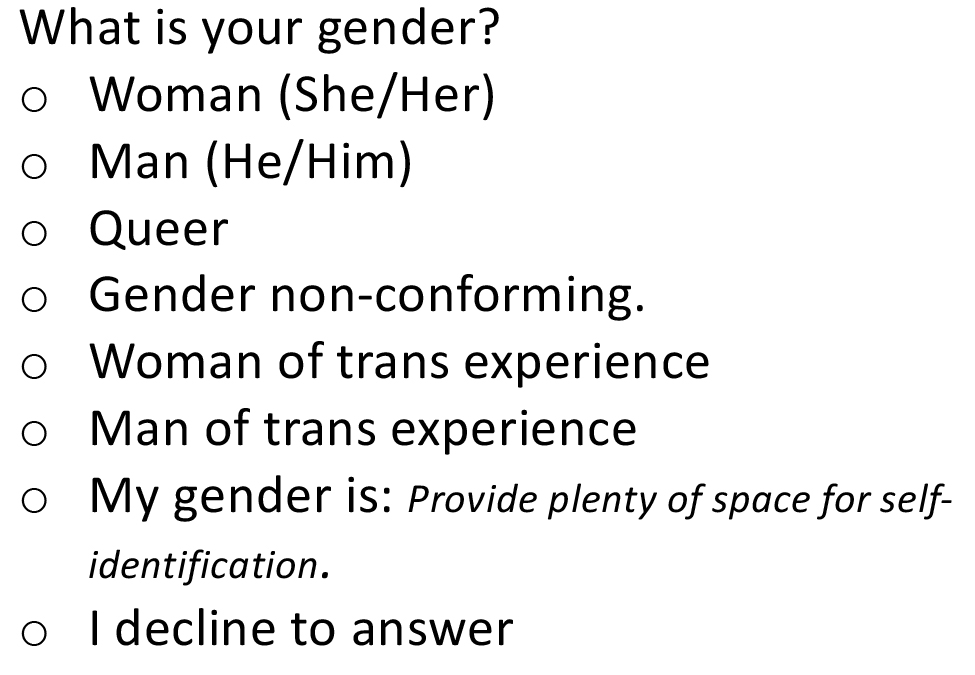
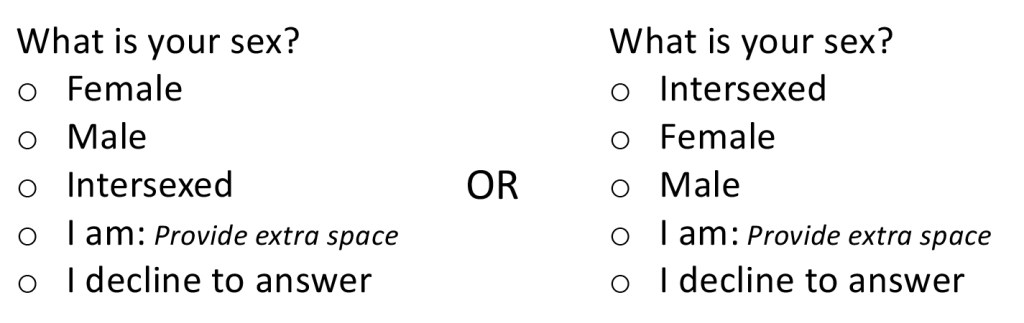
Such a long list could be overwhelming to respondents, and scare those whom we wish to present with the concept that neither sex nor gender are binary. However, if such a list is provided, then respondents should be able to choose multiple genders – choose all that apply. A shorter list may be desirable, but they must allow respondents to indicate they prefer not to answer. For people who do not identify as a gendered man or woman, gender can be a significant source of stress, a very personal matter, and/or fluid through life and situation, and as such gender questions may unintentionally trigger negative emotional responses. Respondents must be allowed to define their own gender in a safe space. Creating this safe space requires not using Other. Try simply replacing Other with, “My gender is…” or “I am…”, which empowers self-definition and individuality, while weakening external conformity to a binary view of gender and sex. It also provides space for culture and ethnicity to enter the space of identity. For example, the First Nations People’s concept and acceptance of Two-Spirit people: https://indiancountrytoday.com/archive/8-misconceptions-things-know-two-spirit-people.
Perhaps the best approach is to go a step further and not provide any options other than self-definition of sex or gender (depending upon the abilities of those analyzing the data). This could or would be exceptionally powerful, as you are removing male/female and woman/man or other gender terms from view, which will prevent reinforcement of binary sex and gender terms and remove their perceived relation as fixed compared to self-identifying terms. Alternatively, you might elect to include a few or several non-binary genders along with an option to self-define and decline to answer (as shown above). If choosing to have multiple options, it is important to have the choices shuffled so that the terms male/female and man/woman are not always listed at the top, as this too implies a rank to the choices listed and introduces bias both in the question and in the implications for gender and sex the question reinforces. We recognize that gender expression can include an exceptionally long definitional list and one that changes rapidly, but including some of these alternative and non-binary options will signal to LGBTQI+ members and allies that you are cognizant of gender diversity and non-binarity. What is key to getting this right is realizing you may get it wrong, but trying goes a long way towards building trust amongst marginalized groups. This perspective applies to many underrepresented groups, but here we believe this is an especially important issue for the LGBTQ+ and ally community. If I was willing to take 5-15 minutes to fill out your survey, then you can take 5-15 minutes to better design questions recognizing the diversity that exists and how simple choices of words can impact and linguistically reinforce power structures.
One further point on surveys
Almost invariably male or man is always the first option. Again, language and presentation matter in terms of constructing and reinforcing cultural power structures. Many – we would venture to say most, present males/men as the first choice above females/woman. It is subtle, but it is these subtleties that we must recognize, reflect on their implications in reinforcing power structures, We MUST recognize how language, structure, and things we take as common have very powerful impacts on our ability to enact change that hopefully has an impact or result in desired inclusivity.
** Please note these thoughts and perspectives are Deanna Grimstead’s best attempt to suggest we need to consider some changes and then talk about what those changes should be. There is no right answer, just like there is not one right and true binary sex or gender, but let’s start the conversation.
Further/suggested readings:
Toward a Feminist Theory of the State. Catharine A. MacKinnon (1989). Harvard University Press.
Beyond the Gender Binary. Beyond the Gender Binary (2020). Pocket Change Collective.
Being Jazz: My Life as a (Transgender) Teen. Jazz Jennings (2017). Ember.
Sovereign Erotics: A Collection of Two-Spirit Literature (2011). University of Arizona Press.
 Diversity, Equity, Inclusion, and Ecology