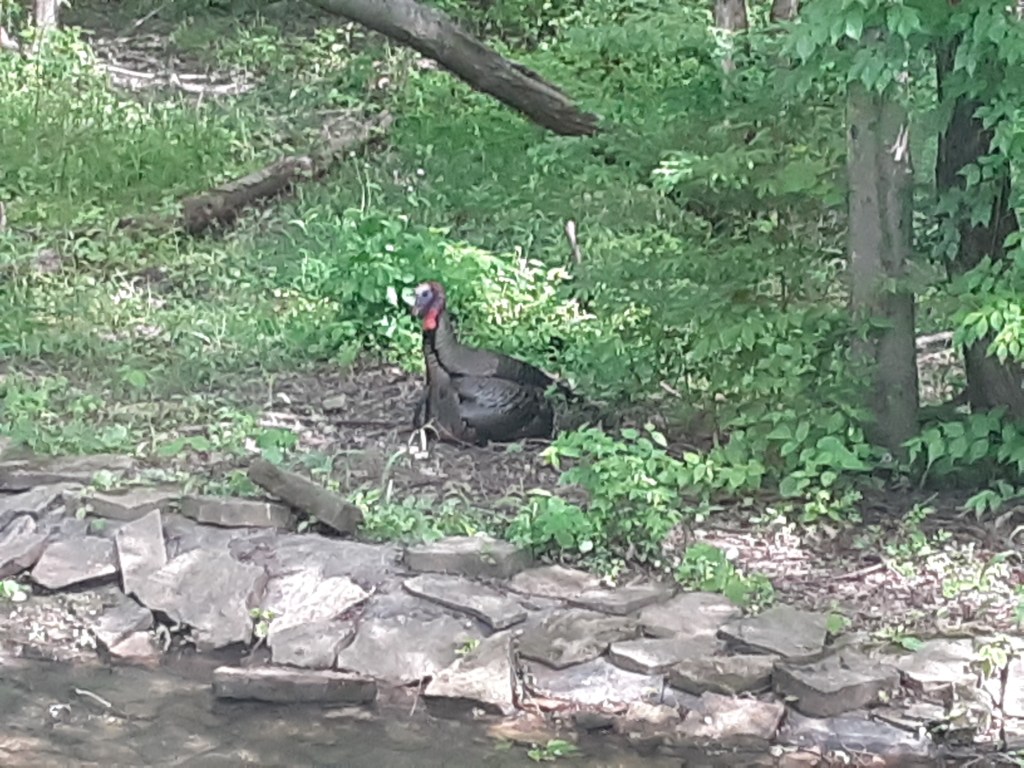
Eastern Turkey foraging and resting in Blackjack Woods Metro Park 
Merriam’s Male Turkey displaying protective wing dragging (territorial warning)
* Professor Grimstead’s blog will be using biological classification names. Unfortunately, there is no way around this, because of the nature of discussing paleontological birds that came before the modern turkey and for some birds there is no common name. The Amateur Entomologists’ Society is a good quick place to brush up on biological classifications:
https://www.amentsoc.org/insects/glossary/terms/biological-classification
Predecessors of the Modern North American Turkey
The North American Turkey (Meleagris gallopavo – species name) evolved from the taxonomic family Phasianidae, which became isolated from the Asiatic and European birds. This isolation may have developed from a migration to the Americas when there was a glacial free passage during early Miocene (approximately 23 to 16 million years ago). Early through late Miocene (approximately 23 to 5 million years ago) relatives of the American turkey, were smaller and did not look like the modern wild turkey we see today. The paleontological remains of these ancestors were found in Texas (Rhegminornis calobates) and Nebraska (Proagriocharis kimballensis).
While these Nebraskan and Texan birds are believed to be a subfamily member of Phasianidae (Melegridinae), scientists believe they are not direct ancestors to our modern wild turkey. Current understanding is that by the Late Pliocene (approximately 3.5 to 2.5 million years ago) there were three distinct species, including Meleagris progenes, Meleagris leopaldi, and Meleagris anza. Meleagris leopaldi and Meleagris anza ranged extensively from Florida to California, and they were replaced in geographic distribution by the modern wild turkey Meleagris gallopavo.
Prior to the Middle Pleistocene (approximately 770,000 to 126,000 years ago) there are no paleontological specimens that approach the modern turkey in size and bone structure, but during the middle to late Pleistocene Meleagris leopaldi and Meleagris anza are more similar to the modern wild turkey than Meleagris progenies suggesting they are more closely related. As we continue our time journey towards the turkey species of the Late Pleistocene to early Holocene four distinct species are recognized. Two are now extinct, the California turkey (Meleagris californicus) and Meleagris crassipes and two are the modern wild turkey species we see today, the North American turkey (Meleagris gallopavo) and the Ocellated turkey (Meleagris ocellata). The Oscellated turkey only exists in the Yucatán Peninsula in Mexico and is significantly more colorful than the North American Turkey, which is distributed throughout many regions in United States and Northern Mexico (visit the National Wild Turkey Federation for ranges and more information: https://www.nwtf.org).
The California turkey was first discovered at the La Brea Tar Pits (https://tarpits.org), but became geographically isolated in Southern California likely during the early Holocene (approximately 11,700 to 8,200 years ago), when we see mass extinctions of Megafauna, such as the Mammoth and Giant Sloth, throughout the Americas. To date the California Turkey has not been found in the remains of prehistoric people’s food trash, but Meleagris crassipes did make it into paleo people’s menus in the Southwestern and Four Corners Regions of the United States at least during the early Holocene.
Interestingly, the prehistoric people of these regions were not eating Meleagris gallopavo, when they were eating leading to the conclusion that Meleagris gallopavo did not temporally overlap with Meleagris crassipes during the early to middle Holocene. Today Meleagris gallopavo merriami (a subspecies of Meleagris gallopavo) ranges where Meleagris crassipes once did, and some have suggested Meleagris gallopavo merriami has rewilded and came to occupy the habitats vacated after Meleagris crassipes extinction. Amadeo Rea has suggested one or two Mexican domesticated forms of Meleagris gallopavo were transported with other domesticates including, maize, beans, and squash into the American Southwest and some of these birds returned to the wild.
Coming Soon: Turkey Blog #2 – The Wild Turkey’s behavior, habitats, and subspecies
Citations and Further Readings
Bocheński, Z.M. & Campbell, Jr., K.E. (2006). The Extinct California Turkey, Meleagris californica, from Rancho La Brea: Comparative Osteology and systematics. Contributions in Science, Natural History Museum, Los Angeles County, 509:1-92.
Brodkorb, P. (1964). Catalogue of Fossil Birds: Part 2 (Anseriformes through Galliformes). Bulletin of the Florida State Museum, Biological Sciences, 8(3):195-335.
Fontana, B.L. (1979). Tarahumara: Where Night is the Day of the Moon. Northland press
Grayson, D.K. (1977). Pleistocene Avifaunas and the Overkill Hypothesis. Science, 195:691-693.
Howard, H. (1963). Fossil birds from the Anza-Borrego Desert. Contributions in Science, Natural History Museum, Los Angeles County, 73:1-33.
Howard, H. (1936). A new record of Parapavo californicus (Miller). Condor, 38(6):249-250.
Howard, H. (1927). A review of the fossil bird, Parapavo californicus (Miller), from the Pleistocene asphalt beds of Ranch Le Brea. University of California Publications, Bulletin of the Department of Geology, 17(1):1-56.
Martin, L.D. & Tate, J. (1970). A New Turkey from the Pliocene of Nebraska. The Willson Bulletin, 82(2):214-218.
Miller, L.H. (1940). A new Pleistocene turkey from Mexico. Condor, 42(3):154-156.
Miller, L.H. (1909). Pavo californicus, a fossil peacock from the Quaternary asphalt beds of Rancho La Brea. University of California Publications, Bulletin of the Department of Geology, 5(19):285-289.
Miller, A.H. & Bowman, R. (1956). Fossil birds of the Late Pliocene of Cita Canyon, Texas. The Wilson Bulletin, 68(1):38-46.
Rea, A.M. (1980). Late Pleistocene and Holocene Turkeys in the Southwest. Contributions in Science, Natural History Museum, Los Angeles County, 330:209-224.
Stidham, T.A. (2011). The carpometacarpus of the Pliocene turkey Meleagris leopoldi (Galliformes: Phasianidae) and the problem of morphological variability in turkeys. PaleoBios, 30(1):13-17.
Steadman, D.W. (1980). A Review of the Osteology and Paleontology of Turkeys (Aves: Meleagridinae). Contributions in Science, Natural History Museum, Los Angeles County, 330:131-207.
Stone, D. (1943). The Talamancan Tribes of Cost Rica. Papers of the Peabody Museum of Archaeology and Ethnology, Harvard University, Vol. 43, No. 2.
 Diversity, Equity, Inclusion, and Ecology